
Sohrab Vazir
Consultant | Founder | Global Citizen
UK Company Share Types: A Complete Guide for Business Owners

When setting up a limited company in the UK, one of the most important decisions is how to structure your share capital. Different company share types in the UK come with different rights, responsibilities, and benefits for shareholders. Choosing the right type of share can impact voting power, dividend distribution, and control of the company.
This guide will break down the main types of company shares in the UK, their features, and why businesses use them.
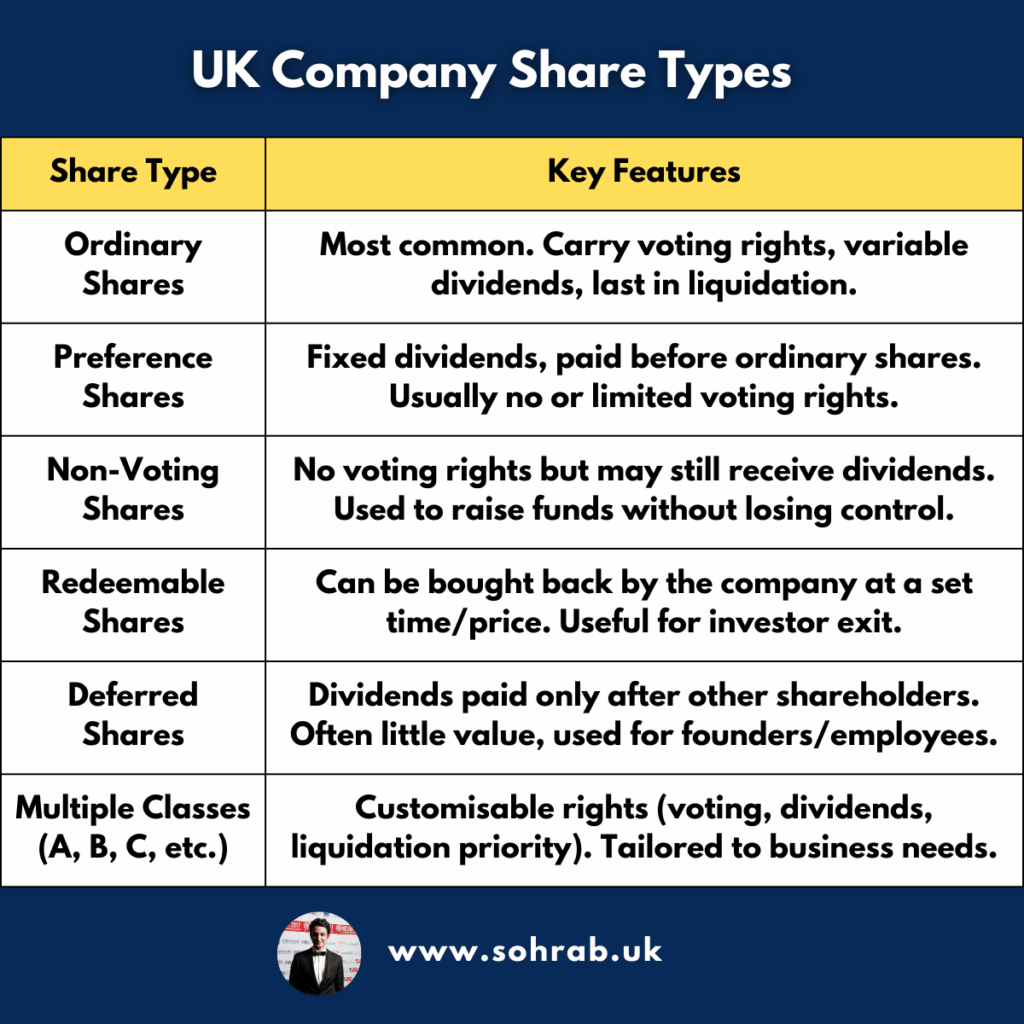
1. Ordinary Shares
- Most common share type in the UK.
- Usually carry voting rights at company meetings.
- Shareholders may receive dividends, which are not fixed and depend on company profits.
- In the event of liquidation, ordinary shareholders are last to be paid after creditors and preference shareholders.
2. Preference Shares
- Give shareholders priority over dividends, often at a fixed rate.
- In case of liquidation, preference shareholders are repaid before ordinary shareholders.
- Typically have limited or no voting rights.
- Popular with investors seeking steady income rather than control.
3. Non-Voting Shares
- Provide entitlement to dividends without voting power.
- Commonly used to raise capital without reducing the control of existing directors or majority shareholders.
4. Redeemable Shares
- Can be bought back by the company at a future date, under terms set at issue.
- Useful for temporary investors or exit strategies.
- Often used in joint ventures or investment deals.
5. Deferred Shares
- Shareholders only receive dividends after other share classes have been paid.
- They usually have little to no immediate value. However, they may be used for founders or employees to retain long-term interest.
6. Multiple Share Classes (“A”, “B”, “C” Shares)
- Companies can issue different share classes with customized rights.
- Differences may include:
- Voting power
- Dividend entitlement
- Priority on liquidation
- For example, a company may issue A shares with full voting rights and B shares with limited rights but higher dividends.
Why Do Share Types Matter?
The choice of company share types in the UK is crucial for:
- Control: Who has decision-making power.
- Profit Sharing: How dividends are distributed.
- Investment: Attracting the right investors.
- Exit Strategies: How shares can be redeemed or transferred.
Therefore, when drafting articles of association, it’s important to clearly define each share type to avoid future disputes.
Understanding company share types in the UK is essential for entrepreneurs, investors, and business owners. Whether you choose ordinary shares for simplicity, preference shares for investor security, or a mix of multiple share classes, the structure should align with your business goals.
If you’re unsure which share structure best suits your company, seek advice from a corporate lawyer or accountant before issuing shares.


About | I’m a UK-based business consultant and venture capital scout. At 22, straight after my postgraduate studies, I founded a Property Technology (PropTech) startup with the support of Newcastle University. Over the following years, I expanded the business to 30+ UK cities, built a team of four, and gained recognition for my entrepreneurial work. Today, I help founders with a range of business services, from structuring and scaling their ventures to connecting with investors and uncovering strategic opportunities for sustainable growth.